

Infraestructura



Besh, Noticias Big Data, Infraestructura
The parametric and non-parametric modelling for Big Data
The Data Science team from Stratesys, in particular the subject matter expert Yaroslav Hernandez Poitomkin explains what is Big Data, how it is applied to different business departments and what are the differences between the parametric and non-parametric modelling.
For further information, you can get in contact with the experts.
Nowadays we are experimenting a data revolution, which means more capacity for data storage and more data volume.
Also, more variety due to newly created tools and ways of communication such as social media, webs and apps. And finally, data velocity and data processing related to data generation processes and business models constraints.
These three concepts, Volume, Variety and Velocity define the “Big data” term. Therefore, if this definition can be applied and integrated into your business processes, it means that you might have the needs of massive data processing and/or analysis.
Many organizations believe that advanced analytics can potentially enhance their business processes related to logistics, marketing, operations and strategy.
Often, these processes are covered by data modelling techniques and methodologies as the core engine of the decision support systems. The decision support systems allow discovering valuable knowledge from the data that reflects the business status and trends always taking into account historical information.
Therefore, an assisted decision making is much more effective than just expert knowledge and intuition only.
Difference between the parametric and non-parametric modelling.
Now, we can introduce a more technical part. There are many tools and solutions related to “Big data” and advanced analytics. The real-world problems are very complex and it is very important to choose an appropriate technique or it even might be the case in which one would need to design their own custom methodology.
There exist two main types of models: parametric models and non-parametric models.
In a parametric model, the data follows a probability distribution with a fixed set of parameters. This is a very appealing setting because the initial assumptions of the model are fulfilled and it is well-based from the theoretical point of view.
The problem with it might arise, for example, when one has multimodality behaviour in the data, which means that many models such as Quadratic Discriminant Analysis (QDA) or Linear Discriminant Analysis (LDA) (Hastie et al. 2008) are not suitable anymore and that the inferences one does might be completely misleading. But for instance, Fisher Linear Discriminant Analysis (FLDA) (Hastie et al. 2008) doesn’t need the normality assumption, neither Principal Component Analysis (PCA) (Jolliffe, I.T. 2013).
The non-parametric models can be regarded as:
- distribution-free methods and
- methods without predefined structure. First sub-type would include models such as kNN, Decision Trees, PCA and the second sub-type would include Support Vector Machines (SVM) (Bishop 2006) and Non-parametric Local Polynomial Regression (Tibshirani 2017).
For instance, in SVM it is very clear that the number of parameters grows with the amount of data as the number of support vectors is bounded by the number of observations. And in contrast to parametric regression models with linear predictor function in which the relationship between the independent and dependent variables is predefined, non-parametric regression provides a more flexible framework as the linearity assumption and the form of predictor function are relaxed, however the errors are still i.i.d. Note that the linearity is always with respect to the parameters, not the data. This will be illustrated in the following example.
In the example from (Pagan and Ullah, 1999) it is taken the logarithm of wage in terms of the age of Canadian male individuals with common education level in 1971. The relationship is assumed to be quadratic in age. The formula of the parametric linear model would be as follows:
Note that this model is still linear with respect to the parameters. 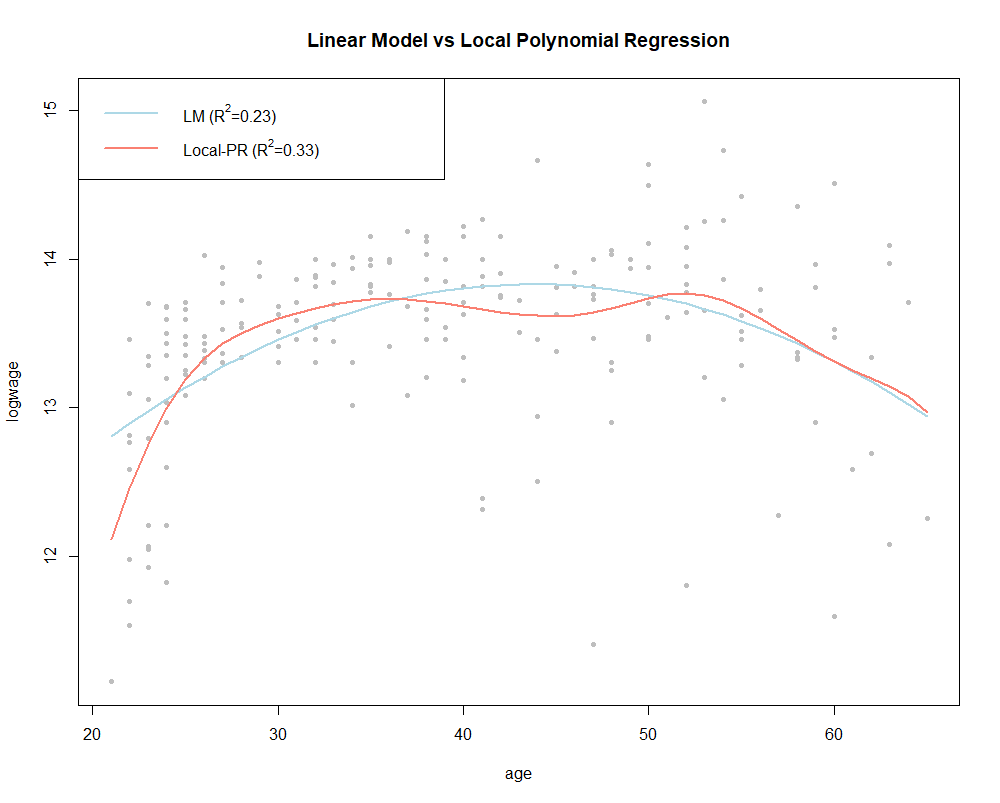
In Fig. 2 it is shown the parametric regression fit versus the non-parametric model.
For the non-parametric model, the bandwidth parameter is estimated by cross-validation using AIC criterion. Actually, in non-parametric modelling, as opposite to linear parametric models, often it is convenient to not to assume homoscedasticity and estimate the conditional variance. The following R code has been used to generate the presented example:
library(“np”)
data(“cps71”)
model.par <- lm(logwage ~ age + I(age^2), data = cps71)
summary(model.par)
model.np <- npreg(logwage ~ age, regtype = “ll”, bwmethod = “cv.aic”, gradients = TRUE, data = cps71)
summary(model.np)
plot(cps71$age, cps71$logwage, type=”o”, ylab=”logwage”, xlab=”age”, main=”Linear Model vs Local Polynomial Regression”)
lines(cps71$age, model.par$fitted.values, col=”lightblue”, lwd=2)
lines(cps71$age, fitted(model.np), col=”salmon”, lwd=2)
legend(“topleft”, legend = c(expression(paste(“LM (“, R^2, “=0.23)”)), expression(paste(“Local-PR (“, R^2, “=0.33)”))), col=c(“lightblue”, “salmon”), lwd=2)














, Infraestructura
The importance of having a disaster recovery plan in the Cloud
The digital revolution has brought great advances and benefits to companies worldwide. Cloud technology has been at the forefront of this revolution since it has allowed both the reduction of costs as well as mobility and flexibility of work for companies. The leading role that technology has brought to the business world also presents a great weakness, any error in a system can result in a disaster for these companies. That is why many companies are already betting on a cloud disaster recovery plan.
This plan, also known as DRaaS o Disaster Recovery as a Service protects data and systems that are hosted in the cloud. At Besh we offer this services as a guarantee against possible economic or structural damages that could take place.
 How does a disaster recovery plan work?
This type of systems is based on technology similar to that used by other cloud services, the hybrid cloud. Its operation relies on continuous data replication from a first information center to a second, where it would remain latent. This information may be required at any time in the event of an alert situation. You could even go back to the previous state thanks to its backup function.
What benefits does the DRaaS have for a company?
Having a recovery plan has a great benefit that is none other than the possibility of avoiding loss of information or systems because of the failures of technology. This would be its main advantage, however, it is not the only one.
This also saves costs for companies, as it does not make it necessary to have a second point of support or to invest in new infrastructures. Added to the cost savings is also time saving. The reaction time will be much shorter, just as it will be the one that is needed to solve the incidents and return the system to its previous state.
These processes can even be automated and in different situations the response can be automatic. There is also a “back” or “return” function which recovers the previous situation despite the accidents that the system may have suffered.
A cloud disaster recovery plan is a service which, moreover, is usually always customized to the specific needs and characteristics of companies. At Besh we offer our clients integral solutions with which to prevent and be prepared in the face of errors and failures on the technology on which a business depends. The safest way to prevent the consequences of what these disasters may bring such as large economic losses or work that must be re-performed.
Sources:
We suggest you create a static block and put it here using shortcode
Recent Comments